




OHIO Owned & Operated  CERTIFIED Mechanics
OHIO Owned & Operated
CERTIFIED Mechanics
AUTO SPARK PLUG REPLACEMENT
If there’s one thing that gives your car the spark it needs to cruise down the road, its the spark plug…actually, trillions of sparks.The spark plug is installed with part of it sticking outside the engine block and the other part protruding inside. How many spark plugs your engine has depends on the size of your engine. In most engines there is one spark plug per cylinder. If you have a four-cylinder engine, then you most likely have four spark plugs. A six-cylinder engine has six spark plugs, and so on.
There are some vehicles, however, that have two spark plugs per cylinder, called dual ignition. Dual ignition originated in airplane engines as a safety feature in case of a spark plug failure. Dual ignition has other benefits as well, like providing for a cleaner burn. Instead of a single spark plug offset from the center of the cylinder, dual spark plugs placed on opposite sides of the cylinder not only burned a higher percentage of the fuel, but also burned hotter and faster.
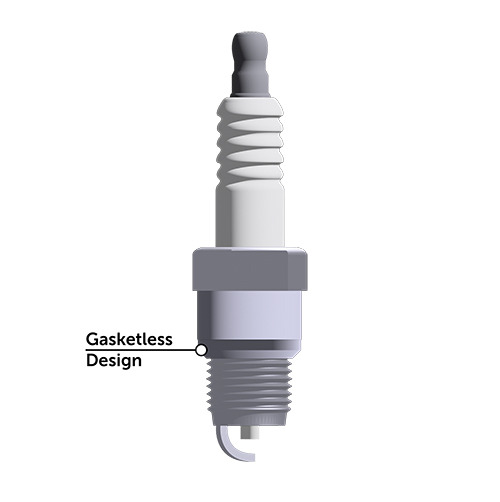
Spark plugs are built to sustain a beating. Not only does the spark plug have to sustain the regular beating other engine components absorb from driving, it has to receive the up to 40,000 volts of electricity to create the spark, keep that electricity maintained within its confines, while also accepting the brunt of the explosion the spark plug just initiated. With the engine running at thousands of revolutions per minute, the little spark plugs need to be highly durable.
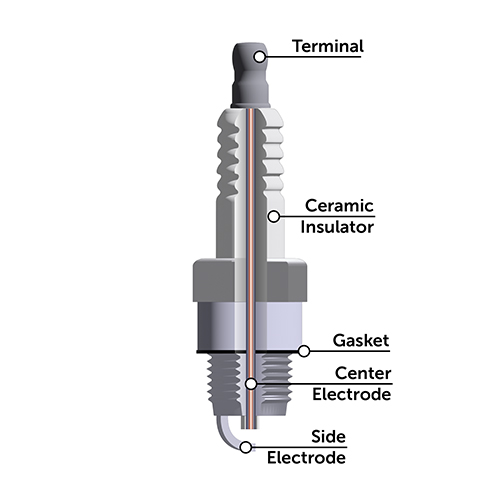
At the top of the spark plug is the Terminal which is the initial contact point from the ignition coil. The Terminal is attached to the Center Electrode which runs the length of the spark plug. The electrodes are constructed with copper as it has excellent conductivity properties. Copper, though, is a softer metal that is more susceptible to damage and has a low melting point. To increase the spark plug durability, manufacturers plate the copper with a more durable metal.
When starting your car, the spark plug accepts the electrical current delivered from the battery through the starter. After the engine turns over, the alternator takes over and delivers the electrical current. When the spark plug (or plugs) receives the electrical current, it shoots through the ceramic insulated center electrode and delivers a small spark to ignite the gas and air mixture within the cylinder head.
 There are three main types of spark plugs.
Copper Spark Plugs
Copper Spark Plugs are the most common with excellent electrical conductivity and low burning temperature. Made of softer copper metal, though, results in lower durability. To improve the spark plugs strength, many manufactures fuse a harder metal to the electrodes exterior.
Platinum Spark Plugs
There are two types of Platinum Spark Plugs, single and double. Single platinum spark plugs feature a single platinum plate welded to the central electrode. Double platinum spark plugs have an additional plate attached to the side electrode.
Platinum is a significantly stronger metal than copper, has better corrosion resistance and burns a bit hotter. The added heat is enough to more likely burn off deposits.
Iridium Spark Plugs
While the side electrode of copper and platinum spark plugs have blunt ends to increase durability, iridium is significantly stronger than either of those metals and is, instead a thin wire. The thin wire conducts electricity better, but even at this small size the valuable metal still pushes the cost above copper and platinum spark plugs.
AUTO SPARK PLUG REPLACEMENT
If there’s one thing that gives your car the spark it needs to cruise down the road, its the spark plug…actually, trillions of sparks. The spark plug is installed with part of it sticking outside the engine block and the other part protruding inside. How many spark plugs your engine has depends on the size of your engine. In most engines there is one spark plug per cylinder. If you have a four-cylinder engine, then you most likely have four spark plugs. A six-cylinder engine has six spark plugs, and so on. There are some vehicles, however, that have two spark plugs per cylinder, called dual ignition. Dual ignition originated in airplane engines as a safety feature in case of a spark plug failure. Dual ignition has other benefits as well, like providing for a cleaner burn. Instead of a single spark plug offset from the center of the cylinder, dual spark plugs placed on opposite sides of the cylinder not only burned a higher percentage of the fuel, but also burned hotter and faster.
Spark plugs are built to sustain a beating. Not only does the spark plug have to sustain the regular beating other engine components absorb from driving, it has to receive the up to 40,000 volts of electricity to create the spark, keep that electricity maintained within its confines, while also accepting the brunt of the explosion the spark plug just initiated. With the engine running at thousands of revolutions per minute, the little spark plugs need to be highly durable.
At the top of the spark plug is the Terminal which is the initial contact point from the ignition coil. The Terminal is attached to the Center Electrode which runs the length of the spark plug. The electrodes are constructed with copper as it has excellent conductivity properties. Copper, though, is a softer metal that is more susceptible to damage and has a low melting point. To increase the spark plug durability, manufacturers plate the copper with a more durable metal.
When starting your car, the spark plug accepts the electrical current delivered from the battery through the starter. After the engine turns over, the alternator takes over and delivers the electrical current. When the spark plug (or plugs) receives the electrical current, it shoots through the ceramic insulated center electrode and delivers a small spark to ignite the gas and air mixture within the cylinder head.
There are three main types of spark plugs.
Copper Spark Plugs
Copper Spark Plugs are the most common with excellent electrical conductivity and low burning temperature. Made of softer copper metal, though, results in lower durability. To improve the spark plugs strength, many manufactures fuse a harder metal to the electrodes exterior.
Platinum Spark Plugs
There are two types of Platinum Spark Plugs, single and double. Single platinum spark plugs feature a single platinum plate welded to the central electrode. Double platinum spark plugs have an additional plate attached to the side electrode.
Platinum is a significantly stronger metal than copper, has better corrosion resistance and burns a bit hotter. The added heat is enough to more likely burn off deposits.
Iridium Spark Plugs
While the side electrode of copper and platinum spark plugs have blunt ends to increase durability, iridium is significantly stronger than either of those metals and is, instead a thin wire. The thin wire conducts electricity better, but even at this small size the valuable metal still pushes the cost above copper and platinum spark plugs.